

About Samantha

Regenerative medicine and exosome therapy involve specialized concepts, so they can feel difficult when you first encounter them.
Samantha is the AI page navigator who helps explain the content of this page in clear English.
On this page, Samantha guides you step by step through the blood-brain barrier, how exosomes are discussed, and why this topic matters in brain-related regenerative medicine.
Samantha is a guide character for Japan Regenerative Medicine Attend Center. She is not a chat service. Diagnosis and medical judgment are made by physicians.
Common Reasons People Explore This Topic

We often hear from people who want to understand regenerative medicine before deciding where to seek consultation.
- I want to learn about new medical information related to brain health
- I want to understand the research behind regenerative medicine
- I want to understand exosome therapy more clearly
- I am not sure which medical institution I should consult
Regenerative medicine is an evolving field, and actual suitability must be judged through medical examination at a qualified institution. Japan Regenerative Medicine Attend Center provides information and guidance to help people organize what they need to know before consultation. For international visitors, the consultation pathway is centered on medical institutions in Japan.
What Is the BBB?

The strong barrier that protects the brain can also become a major obstacle to treatment delivery.
The blood-brain barrier, or BBB, is an important defense system that prevents substances in the bloodstream from entering the brain freely.
Because the brain is one of the body’s most important organs, entry is tightly controlled so that harmful or unnecessary substances do not pass through easily.
For that reason, many drugs and cells are thought to have difficulty reaching brain tissue.
At our center, we view the BBB as one of the key treatment-related challenges in the brain field.
That is why one of the major questions in brain treatment and brain research is how a therapeutic signal can pass through this barrier.
Even drugs already used clinically for symptomatic treatment of Alzheimer’s disease are reported to accumulate in the brain at less than 0.1% of the administered dose, highlighting the importance of efficient BBB-passing delivery technologies.
Source: JST (Japan Science and Technology Agency)
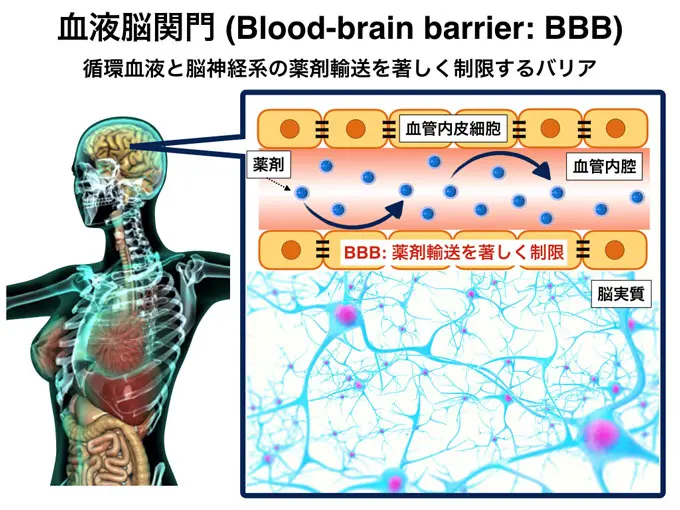
- The blood-brain barrier protects the brain
- Many drugs and cells do not pass through easily
- Nano-sized particles are being studied for their possible ability to reach the brain
The Limitation of Existing Approaches and the Wall of the BBB
In regenerative medicine, stem-cell-based treatment research has advanced across many areas. In the brain field, however, the blood-brain barrier remains one of the major structural challenges.
The BBB blocks substances in the bloodstream from moving freely into brain tissue, and this plays an important protective role. At the same time, it may also make it difficult for treatment-related substances or cells to reach the brain. In research settings, larger cells such as stem cells are often discussed as facing delivery challenges in brain applications.
Against this background, more attention has recently shifted from whole cells to exosomes, which are signaling particles secreted by cells. Because exosomes are nano-sized, they have attracted interest as a newer research target in the brain field, especially in connection with BBB-related delivery questions.
What Is Brain Exosome? A Nano-Sized Repair Capsule Discussed in BBB Research
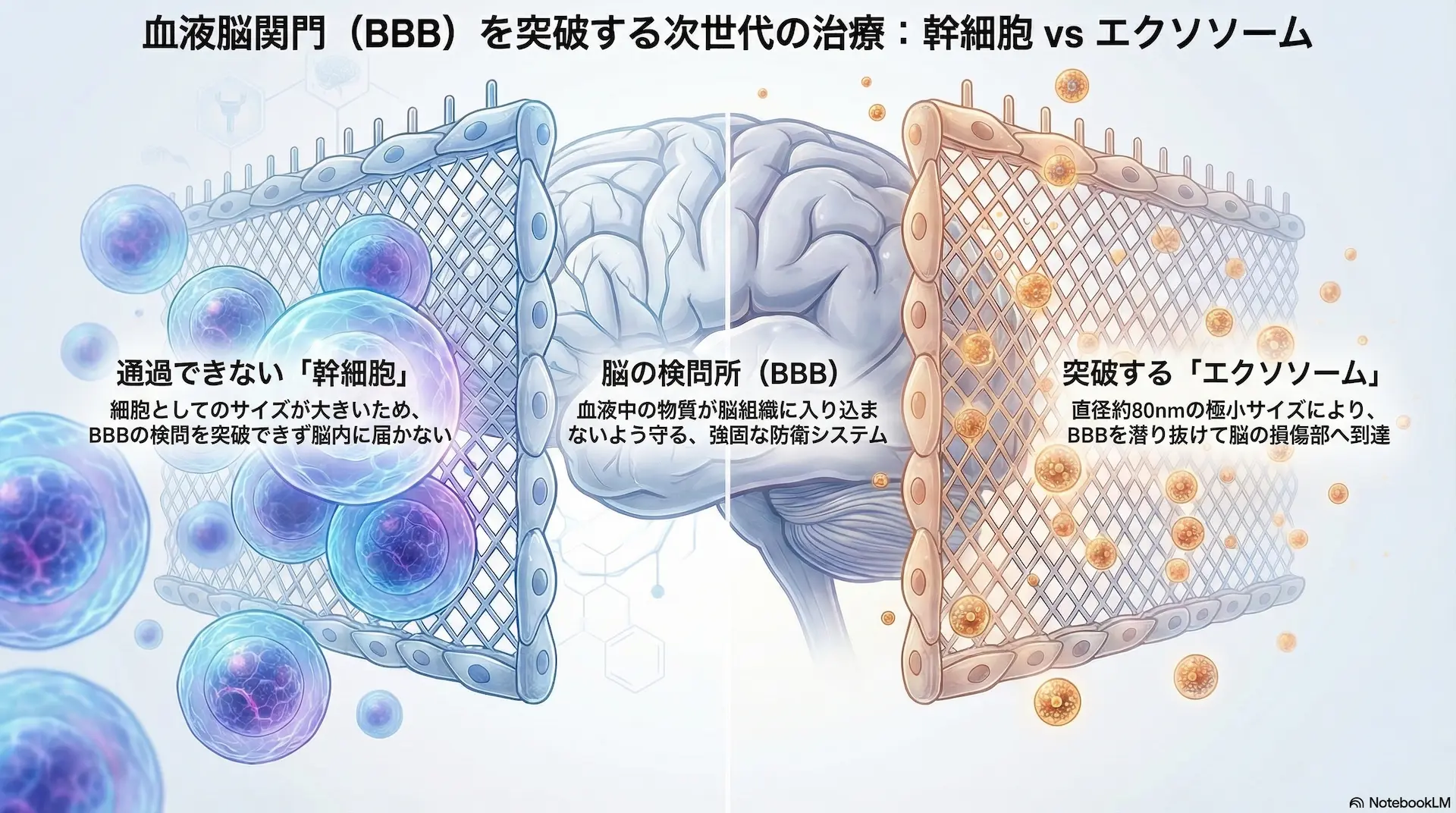

Exosomes discussed in the brain field are often described as very small particles with a diameter of about 80 nm. Because of this nano-sized profile, they are being studied in relation to BBB passage and cell-to-cell communication in brain tissue.
The amniotic-derived exosomes introduced on this page are a type of extracellular vesicle secreted by cells related to the amniotic membrane surrounding the fetus. In regenerative medicine research, amniotic-derived cells have attracted interest from the perspective of repair-related factors and anti-inflammatory factors, and the exosomes secreted by those cells are also under study.
- Neprilysin (NEP): an enzyme discussed in relation to the breakdown of amyloid beta (Aβ), often described as a “clean-up” target in Alzheimer’s-related research.
- Bioactive peptides such as BNP and bradykinin: discussed in relation to tissue protection and the internal environment that may support repair.
- Neurotrophic factors: discussed in relation to neuronal survival and the maintenance or reconstruction of neural networks.
These factors are being studied in relation to the brain environment, neuronal protection, and network maintenance. However, their detailed mechanism and clinical significance remain under research, and applicability to any individual condition must be judged by a physician.
Research on how exosomes function inside the body continues to expand, but this page does not guarantee treatment outcome.
The Potential Strength of Amniotic-Derived Exosomes
Even among exosomes, their properties may differ depending on where they come from.
At our center, we pay attention to the idea that the origin of exosomes may influence their characteristics. Among these origins, amniotic-derived material is one of the better-known themes in regenerative medicine research.
Amniotic-derived cells have been studied in relation to repair-associated and anti-inflammatory factors, and they continue to attract attention in regenerative medicine.
Research also discusses the possibility that amniotic-derived material may have relatively low immunogenicity, and exosomes secreted from such cells are being studied from that perspective as well.
Possible future applications remain in the research stage, but this is one of the topics receiving attention in regenerative medicine, including the brain field.
Manufacturer: Cell Lead International
Here is an overview of the manufacturer behind the exosomes introduced on this page.
The exosomes used in this treatment context are manufactured by Cell Lead International.
Cell Lead International is a regenerative medicine-related company engaged in exosome research and manufacturing.
According to the provided materials, the company manufactures purified exosomes through additional processing steps beyond stem cell supernatant preparation, and the product is described as being produced under strict quality control with the following features.
- Amniotic-derived cells
- Japanese donor origin
- Particle size of about 80 nm
- About 500 billion particles per vial
Manufacturing materials also describe sterility and quality testing during the production process.
Brain Areas in Which Brain Exosome Research Is Being Explored
In response to the challenge posed by the blood-brain barrier, exosome research is being watched as a new possibility in brain-related regenerative medicine. Here we introduce several neurological areas that have attracted particular attention in ongoing research.
One of the longstanding difficulties in treating brain disorders has been the challenge of delivering an approach to the brain itself.
The brain is protected by a strong defense system called the blood-brain barrier, and this creates a structural problem in which many treatment substances and cells cannot pass through.
In recent regenerative medicine research, exosomes have attracted attention as a newer approach to this challenge.
Exosomes are extremely small particles, often described as around 80 nm in diameter, and act as nano-sized messengers for cell-to-cell communication.
Because of this small size, exosomes are being studied in relation to the BBB and to the brain field more broadly. The following sections outline several major neurological contexts now under study.
Stroke After-Effects (Post-Acute Phase)
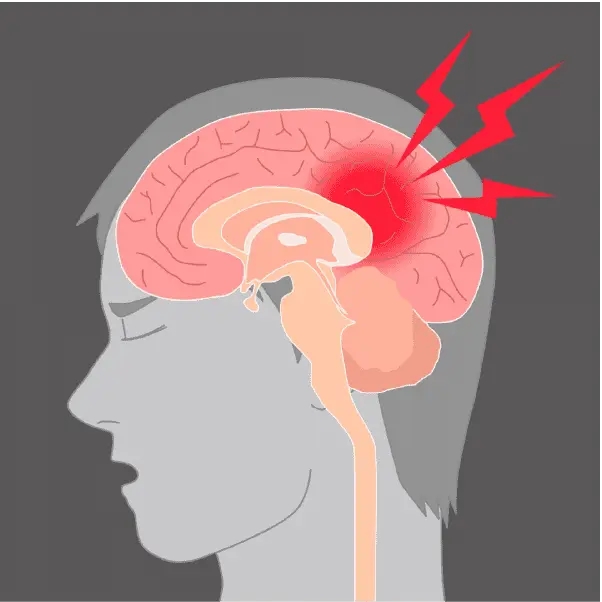
Stroke is a condition in which brain tissue is damaged by blocked blood vessels in the brain.
Even after the acute phase has passed, symptoms such as paralysis, numbness, and language impairment may remain, and recovery varies widely by individual.
In regenerative medicine research, exosomes are being explored as a newer approach in relation to the post-injury brain environment, inflammatory responses, and neuronal protection.
Factors contained in exosomes are being studied in relation to anti-inflammatory effects and neuroprotection, including possible links between changes in the brain environment and functional recovery.
Some reports suggest changes in physical function, but clinical evaluation still requires careful verification.
Assessment after stroke must be individualized by a physician, but interest in regenerative medicine information for post-stroke conditions continues to grow.
Alzheimer’s Disease
Alzheimer’s disease is a neurodegenerative disorder characterized mainly by memory impairment and decline in cognitive function.
Research has discussed its relationship to amyloid beta accumulation and inflammatory responses in the brain, and new research approaches continue to be explored alongside efforts to better understand the disease process.
In exosome research, neprilysin has received attention as an enzyme that may be involved in amyloid beta breakdown.
Research is also progressing on the relationship between exosome-associated factors, neuronal protection, and maintenance of neural networks.
These findings remain in the research stage, and actual treatment suitability must be determined by a physician.
Exosomes continue to be explored as a new research area in neurodegenerative disease.
Parkinson’s Disease
Parkinson’s disease is a neurological disorder considered to be related to degeneration of dopamine neurons in the brain.
Well-known symptoms include tremor, rigidity, and slowness of movement, although symptom pattern and severity vary between individuals.
In regenerative medicine research, exosomes are being studied in relation to maintenance of neuronal function and inflammatory responses.
Factors contained in exosomes are being examined for possible connections to neuronal protection and maintenance of neural networks.
Research is also investigating the relationship between changes in the brain environment and neural transmission, though clinical meaning remains to be clarified.
This page is intended to provide information about regenerative medicine research and does not guarantee any specific treatment effect. Treatment suitability must be judged by a physician.
Scientific Reviewer

The information on this page is reviewed from a research perspective.

Choi Ehn-kyoung
PhD, The University of Tokyo / CTO / Exosome Research (Cell Lead International)
This project is reviewed based on specialized knowledge related to exosome research and manufacturing.
The reviewer is not the person responsible for medical treatment. Final treatment suitability must be judged by the physician in charge at the medical institution in Japan.
Would You Like to Explore Regenerative Medicine Consultation?
Brain-related regenerative medicine is a developing field, and treatment suitability varies depending on each patient’s condition. Japan Regenerative Medicine Attend Center provides information and guidance to help patients connect with appropriate medical institutions in Japan.
For overseas patients, consultation and treatment are handled in Japan, so travel to Japan is generally required if you move forward. Please feel free to contact us first about your current symptoms or situation.
Brain Exosome ConsultationEvidence Related to Safety and Reliability
In regenerative medicine, it is important to review safety-related information carefully. Based on the materials provided to us, we also explain manufacturing processes and testing items associated with safety evaluation.
- Safety considerations related to the fact that exosomes are not whole cells: Because exosomes are not cells themselves, safety is discussed on somewhat different terms than in cell therapy.
- Research features associated with amniotic-derived origin: Amniotic-derived cells have been studied for the possibility of relatively low immunogenicity, and exosomes secreted from them are also being discussed in related research.
- Quality tests described in the materials: The provided materials describe items such as sterility testing, endotoxin testing, and safety evaluation. Detailed applicability must still be confirmed by a physician during consultation.
Regenerative medicine can only demonstrate its full value when it is supported by a careful foundation of safety and trust.
Effects may vary by individual, and treatment suitability is judged by a physician.
The explanations on this page are structured from materials confirmed by our center.
Video (YouTube)
We also provide a video so that you can explore this topic in more detail.
The YouTube embed will appear here.
Audio Content
We also provide audio-style content for people who want to listen while traveling or working.
The YouTube audio version will appear here.
The audio content is currently provided as a YouTube audio-style video.
FAQ
Q What is exosome therapy?
A Exosomes are tiny particles secreted by cells and are being studied in the field of regenerative medicine. Treatment suitability and detailed medical explanation are provided by physicians during consultation at a medical institution.
Q Can I receive treatment immediately?
A A physician must first examine you and determine whether treatment is appropriate.
Q Is this treatment suitable for everyone?
A No. A physician determines suitability individually according to the patient’s condition.
Q Can I contact you just for consultation?
A Yes. We provide information on regenerative medicine and guidance toward appropriate medical institutions.
Q Which medical institution can provide this treatment?
A Please contact us through the inquiry form. We guide you according to your situation.
Q Can I ask about brain exosome options for stroke after-effects?
A Research on regenerative medicine for post-stroke conditions is ongoing, and we also receive inquiries from people seeking information about brain exosome approaches. Actual suitability must be judged individually by a physician based on current symptoms and clinical course.
Q What is regenerative medicine for stroke after-effects?
A In post-stroke regenerative medicine research, attention is often given to the post-injury brain environment and maintenance of neurological function. Specific treatment details and actual suitability are determined by physicians through medical examination.
Q Is there a specific time to consider regenerative medicine after stroke?
A Because post-stroke condition and recovery course differ from person to person, there is no single timing rule. A physician must determine this individually after examination.
Q How are stroke and exosome research related?
A In stroke-related exosome research, relationships to inflammation, neuronal protection, and changes in the brain environment are being studied. Because this includes research-stage content, actual medical use must be judged by a medical institution.
Q Can I also ask about paralysis or numbness after stroke?
A Yes. We provide information on regenerative medicine and guidance toward medical institutions for symptoms such as paralysis, numbness, and language impairment seen after stroke. Final medical judgment is made by a physician.
Q What is the blood-brain barrier?
A The blood-brain barrier is a biological barrier that restricts substances in the bloodstream from freely entering the brain. It is an important protective system, but research also identifies it as a challenge for delivering drugs or cells to the brain.
Q Why is the blood-brain barrier important in brain regenerative medicine?
A In the brain field, one major issue is how a treatment-related substance can pass through the BBB. That is why the relationship between nano-sized exosomes and the BBB is also being studied.
Q What are amniotic-derived exosomes?
A Amniotic-derived exosomes are a type of extracellular vesicle secreted by cells originating from the amniotic membrane. Amniotic-derived cells have attracted interest in regenerative medicine research, and exosomes secreted from them are also under study.
Q Are amniotic-derived exosomes safe?
A Safety is judged comprehensively based on manufacturing process, quality testing, and physician review. At our center, we also provide information about quality tests and safety evaluation described in the materials provided to us.
Consultation for Brain Exosome Treatment

Japan Regenerative Medicine Attend Center provides regenerative medicine information and medical provider guidance. For brain exosome topics, we help organize information according to your current condition and circumstances and guide patients toward medical institutions in Japan. Please feel free to contact us.
From Inquiry to Treatment Guidance
For overseas patients, the first step is not immediate treatment booking. We begin by reviewing your situation, organizing basic medical information, and then guiding you toward an appropriate medical institution in Japan if consultation appears reasonable.

Please send your inquiry with your current symptoms, diagnosis if known, age, and the main reason you are considering regenerative medicine in Japan. We will then contact you and explain the overall process.

We will review your current condition, treatment history, and available medical information. If needed, we may ask for additional details so we can better understand whether consultation with a medical institution in Japan is appropriate.

Based on that review, we guide you toward an appropriate medical institution in Japan. If you decide to move forward, the next step is consultation with that institution and travel to Japan for in-person care.